
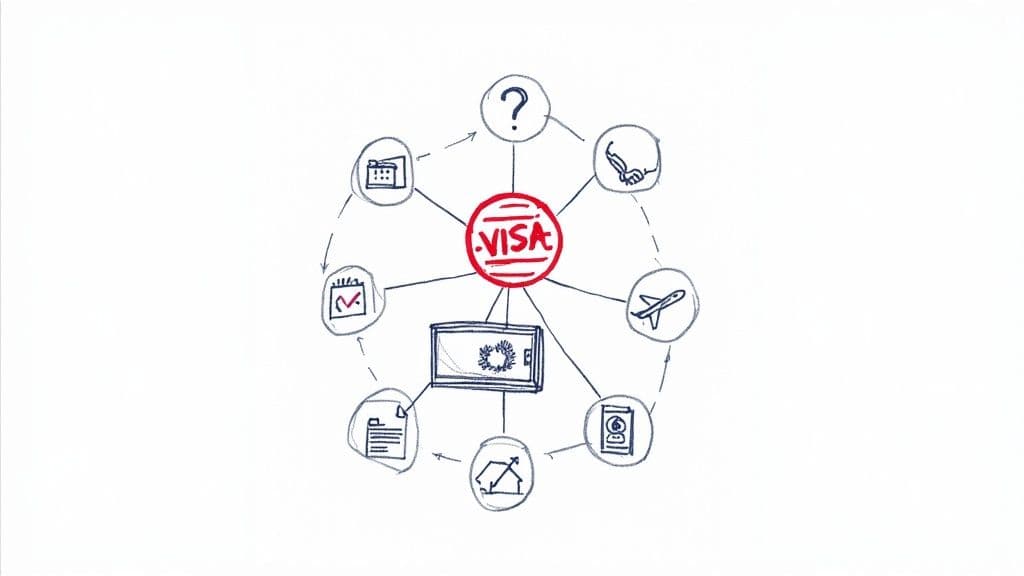
The B1/B2 visa interview is the final, critical step before your planned trip to the United States. In just a few minutes, a consular officer must evaluate your application, and their decision rests on your ability to communicate your intentions clearly and credibly. The key to navigating this process successfully isn't about memorizing pre-written scripts; it's about understanding the core purpose behind the questions you'll be asked. Every query is designed to verify two fundamental points: the legitimacy of your temporary visit and your unwavering intent to return to your home country upon its conclusion.
This comprehensive guide is built to demystify the interview process. We will break down the most common B1 and B2 visa interview questions into eight distinct categories, from your travel purpose to your ties back home. For each category, we provide not just the typical questions but also insight into what the officer is truly trying to ascertain, practical tips for formulating your own authentic answers, and examples to guide you.
Whether you are a first-time applicant from countries like Colombia, Mexico, or Brazil, or an Indian citizen applying from a post in Canada, this article will equip you with the strategic knowledge needed to present your case effectively. We will cover the specific documentation you should have on hand to support your statements for each type of question, ensuring you walk into your appointment prepared, confident, and ready to clearly articulate your plans. Your journey to a successful interview starts with understanding the "why" behind each question.
1. Purpose of Your Visit
This is often the first and most crucial question you'll face. The consular officer’s primary goal is to quickly understand why you want to travel to the United States. Your answer to this foundational question sets the stage for the rest of your interview, helping the officer determine if your intended activities align with the strict guidelines of a B-1 (business) or B-2 (tourism/leisure) visa. A clear, confident, and truthful response is non-negotiable.
The officer is verifying that you are not seeking to work illegally, study without the proper visa, or immigrate. Among all the B1 and B2 visa interview questions, this one most directly addresses your intent. Your answer must be specific, align perfectly with the documents you’ve submitted (like your DS-160 form and invitation letters), and be delivered concisely.
How to Structure Your Answer
A strong answer should be direct and informative, lasting about 30-60 seconds. Structure it to cover the who, what, where, when, and why of your trip.
- State the primary purpose first: Clearly mention if it's for business, tourism, or medical reasons.
- Provide specific details: Mention dates, locations, events, or people you will visit.
- Combine purposes logically: If you have a B1/B2 combined visa application, explain how you will blend both business and leisure activities.
Pro Tip: Think of your answer as the "elevator pitch" for your trip. It should be compelling, easy to understand, and leave no room for doubt about your intentions to return home.
Sample Answers
For a B-1 (Business) Applicant:
- "I am traveling to attend the 'Innovate 2024' technology conference in San Jose, California, from October 14th to 17th. I will also be meeting with two potential clients, XYZ Corp and ABC Inc., to discuss a software partnership."
For a B-2 (Tourism) Applicant:
- "I plan to visit my sister in Orlando, Florida, for two weeks in July to celebrate her son's graduation. We will also spend four days visiting Walt Disney World and the Kennedy Space Center."
For a Combined B1/B2 Trip:
- "I am going to New York for a five-day marketing seminar for my company, from September 9th to 13th. Afterward, my spouse will join me, and we will spend one week sightseeing in New York City and Washington, D.C., before returning home."
2. Ties to Your Home Country
This question gets to the core of U.S. immigration law, which presumes every visa applicant intends to immigrate. Your job is to overcome this presumption by proving you have strong, compelling reasons to return home. The consular officer needs to be convinced that your life, obligations, and assets are so firmly rooted in your home country that you would not abandon them for a life in the United States. This is arguably one of the most critical factors in their decision-making process.
Your response and supporting documents must paint a clear picture of a stable, established life that you have every intention of returning to. Weak or unconvincing ties are a primary reason for visa denials, making preparation for this line of questioning among the most important for any B1 and B2 visa interview questions. The officer will assess your employment, family, financial, and social connections.
How to Structure Your Answer
Your answer should be a concise summary of your strongest ties, supported by documents you can present if asked. Focus on the most significant and easily verifiable connections first.
- Lead with your strongest tie: This is often your job or immediate family.
- Layer in other connections: Mention property, financial assets, or significant community roles.
- Be prepared with proof: Have documents like employment letters, property deeds, and family certificates ready.
Pro Tip: Don't just list your ties; explain why they are important. For example, instead of just saying "I have a job," say "I am a tenured professor with ongoing research projects that require my presence."
Sample Answers
For a B-1 (Business) Applicant from Brazil:
- "My primary ties are my career and family. I am a Senior Marketing Manager at a multinational company in São Paulo, where I have worked for eight years and have a promotion scheduled upon my return. My wife and two young children will remain at our home, which we own, during my trip."
For a B-2 (Tourism) Applicant from Mexico:
- "I have strong ties through my family and property. I live with and care for my elderly parents in our family home in Guadalajara, which I co-own. I also have a stable job as a graphic designer, and my entire family resides in the same city."
For a Student Applicant from Colombia:
- "I am in the final year of my engineering degree at the National University of Colombia in Bogotá. I must return to complete my final exams and thesis project to graduate. My parents, who are sponsoring my trip, and all my siblings live in Colombia."
3. Planned Duration and Itinerary
Following the purpose of your visit, the consular officer will almost always ask about how long you plan to stay and what you intend to do. This question directly assesses whether your trip is well-planned, temporary, and fits the scope of a B-1 or B-2 visa. A vague, unrealistic, or poorly defined itinerary can be a major red flag, suggesting you might overstay or have intentions other than those declared.
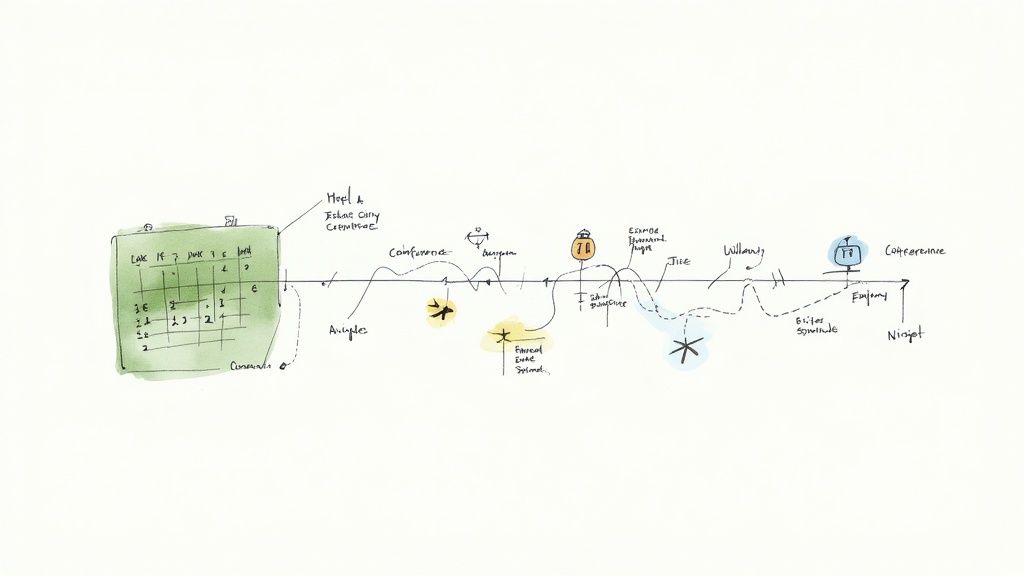
The officer is looking for consistency between your verbal answers, your DS-160 form, and your supporting documents like hotel bookings or conference registrations. A concrete plan demonstrates that you are a genuine visitor with a clear objective and a firm departure date. Among the common B1 and B2 visa interview questions, this one tests your preparedness and the credibility of your stated purpose.
How to Structure Your Answer
Your answer should be a concise summary of your travel plans. Be ready to provide more detail if asked, but start with a clear overview that includes the total duration and key activities.
- State the total duration first: Begin by clearly stating the number of days or weeks you plan to stay.
- Outline key activities chronologically: Briefly describe the main events of your trip in the order they will happen.
- Connect activities to locations: Mention the cities you will visit and what you plan to do in each one.
Pro Tip: Have a printed copy of your detailed day-by-day itinerary with you. While you might not be asked for it, having it ready shows you are organized and serious about your plans.
Sample Answers
For a B-1 (Business) Applicant:
- "I will be in the United States for seven days. I arrive in Houston on May 20th. I have meetings scheduled at my company’s headquarters from May 21st to May 23rd for annual training. I will then fly home on May 26th."
For a B-2 (Tourism) Applicant:
- "My trip will be for 10 days. I'll arrive in New York City on March 15th. For the first five days, I’ll be sightseeing and visiting museums. Then I'll travel to Boston for three days to visit a university friend before flying back home from Boston on March 25th."
For a Combined B1/B2 Trip:
- "I plan to stay for a total of 14 days. I will arrive in Miami on June 1st to attend a three-day trade show for my business. After the show ends on June 4th, I will spend the next ten days on a family vacation visiting theme parks in Orlando and the beaches in Clearwater before my return flight on June 15th."
4. Financial Capacity to Support Your Trip
One of the consular officer's main responsibilities is to ensure you can afford your trip without resorting to unauthorized employment in the United States. This question directly assesses your financial stability and whether you have sufficient funds to cover all your intended expenses, from flights and accommodation to daily spending. Proving you have adequate financial backing is a critical way to show you are a genuine visitor with no intention of violating your visa terms.
The officer will scrutinize your financial evidence to see if your stated plans are realistic and if your funds appear legitimate. Among the many B1 and B2 visa interview questions, this one requires you to be transparent and well-prepared with documents like bank statements, pay stubs, or sponsorship letters. Your answer should clearly demonstrate that financial desperation will not be a factor during your stay.
How to Structure Your Answer
Your answer should be factual, confident, and supported by the documents you have on hand. Be ready to provide a concise breakdown of your trip's estimated cost and how you plan to cover it.
- State the total estimated cost: Start by giving a clear figure for the entire trip.
- Show your funding sources: Specify whether you are self-funding, sponsored by your employer, or supported by a family member.
- Be ready with proof: Mention the documents you have brought to verify your claims, such as bank statements, a letter from your employer, or an affidavit of support.
Pro Tip: Avoid bringing documents showing sudden, large, and unexplained deposits into your account just before the interview. Consular officers are trained to spot these as potential red flags. Consistent income and a stable account balance are far more convincing.
Sample Answers
For a Self-Funded B-2 Applicant:
- "I have estimated the total cost for my two-week trip to be approximately $4,000. I have savings of over $15,000 in my bank account, and I've brought the last six months of my bank statements and my employment letter to show my stable income."
For a Company-Sponsored B-1 Applicant:
- "My company is covering all expenses for this business trip, with a total budget of $5,000. I have a letter from my employer confirming this sponsorship, which details the funds allocated for my flights, hotel, and daily expenses. I also have $8,000 in my personal savings for any personal activities."
For a Sponsored B-2 Applicant (e.g., Student visiting family):
- "My father is sponsoring my visit. We estimate the trip will cost around $3,500. He has provided a notarized affidavit of support and his bank statements to show he can fully cover my expenses during my stay." To understand the requirements for this crucial document, you can learn more about the affidavit of support for a tourist visa.
5. Employment Status and Company Details (For B1 Applicants)
For those applying for a B-1 visa, this line of questioning is critical. The consular officer needs to confirm that your business visit is legitimate and directly tied to your professional role in your home country. These questions are designed to verify that you are a genuine employee, that your company is a real entity, and that your reasons for visiting the U.S. are strictly for permissible business activities, not unauthorized employment.
The officer is assessing the stability of your professional life, which serves as a powerful tie to your home country. A well-established career indicates you have compelling reasons to return after your business trip. Among the many B1 and B2 visa interview questions, these are specifically aimed at B-1 applicants to prevent misuse of the visa for job-seeking. Your answers must be precise, consistent with your DS-160, and backed by documents like an employment verification letter.
How to Structure Your Answer
Your response should be confident, factual, and detailed enough to paint a clear picture of your professional role and the purpose of your trip. Aim to be both thorough and concise.
- State your role and company clearly: Start with your job title, the company you work for, and how long you've been there.
- Briefly describe your responsibilities: Give the officer a clear understanding of what you do.
- Connect your job to the U.S. trip: Explicitly state how the conference, meeting, or training in the U.S. is essential for your current role.
Pro Tip: Have your business cards ready and be prepared to provide details about your company, such as its size, what it does, and even your supervisor's name. This level of detail demonstrates authenticity.
Sample Answers
For a Corporate Employee:
- "I am a Senior Software Engineer at Tech Solutions in Bogota, Colombia, where I have worked for five years. I lead a team that develops cloud infrastructure, and I'm traveling to our headquarters in Seattle for a week to attend an internal developers' summit and collaborate with our U.S.-based partners on our next project."
For a Manager or Executive:
- "I am the Regional Sales Manager for XYZ Consulting in Johannesburg, South Africa. I've been with the company for eight years and manage a team of 12 sales representatives. I am visiting to meet with two major clients in Chicago and to pitch a new service contract to a potential partner."
For a Self-Employed Professional:
- "I am a self-employed architectural design consultant based in Mexico City. I have been running my own registered business for five years. I'm visiting to meet with a potential U.S.-based client in Los Angeles to finalize the contract for a new commercial building project."
6. Sponsorship and Invitation Details (If Applicable)
If your trip to the U.S. is being sponsored by a company or an individual, the consular officer will scrutinize this relationship closely. Their goal is to verify the legitimacy of the sponsor, understand their financial capacity to support your visit, and ensure the relationship is authentic. This line of questioning helps them assess whether the sponsorship is a genuine arrangement or a potential cover for illegal work or an attempt to overstay your visa.
Among the many B1 and B2 visa interview questions, those about your sponsor are designed to confirm that you have a credible reason for your visit and that you won't become a public charge. Your answers must be supported by strong documentation, such as a formal invitation letter, proof of the sponsor's status, and evidence of your pre-existing relationship. Clarity and consistency between your verbal statements and your paperwork are paramount.
How to Structure Your Answer
Your response should be direct, professional, and backed by the documents you have on hand. Be ready to present the invitation letter and other supporting evidence without being prompted.
- Identify the sponsor immediately: Clearly state whether it's a company or a person.
- Explain the relationship: Briefly describe how you know the sponsor (e.g., business associate, close relative, conference acquaintance).
- Reference your documentation: Mention the invitation letter, affidavit of support, or other key documents you have brought.
Pro Tip: Have all sponsorship-related documents organized in a separate folder for quick access. Being able to swiftly present a detailed, professional invitation letter can significantly strengthen your credibility and save time.
Sample Answers
For a B-1 (Business) Applicant:
- "My visit is sponsored by ABC Corporation in Austin, Texas. Here is the official invitation letter from their Vice President of Global Sales, Mr. John Doe. I connected with him at the London Tech Summit last year, and they are covering my flights and accommodation to finalize a partnership agreement."
For a B-2 (Tourism) Applicant:
- "My cousin, who is a U.S. citizen living in Chicago, has invited me to visit for my graduation celebration. He has provided a formal affidavit of support, and I have copies of his bank statement, employment letter, and passport to show he can support my stay."
For a Medical Treatment Applicant:
- "The 'Heal Well Foundation' is sponsoring my medical consultation at the Mayo Clinic. I have their official sponsorship letter, which outlines their commitment to cover all medical and living expenses, along with my appointment confirmation from the hospital."
7. Previous US Visits and Travel History
Your past travel record, especially to the United States, is a critical part of your immigration profile. Consular officers will ask about your travel history to verify your consistency, assess your credibility, and confirm that you have previously complied with U.S. immigration laws. This question helps them build a picture of you as a trustworthy, non-immigrant visitor who respects visa regulations.
The officer is looking for red flags like previous visa overstays, attempts to work on a tourist visa, or any discrepancies between your current application and past trips. Among the various B1 and B2 visa interview questions, this one directly tests your honesty and reliability. A clear, accurate account of your travel history demonstrates that you are a low-risk applicant who will adhere to the terms of the visa you are seeking.
How to Structure Your Answer
Your response should be factual, chronological, and completely aligned with the information in your passport and previous applications. Be prepared to recall dates, durations, and purposes of past visits accurately.
- Be honest and precise: State clearly if you have visited before or if this is your first time.
- Provide key details for each trip: Briefly mention the year, purpose (e.g., tourism, business meeting, family event), and duration of your stay for each previous U.S. visit.
- Address any issues proactively: If you have a previous visa denial or a complicated travel history, be prepared to explain it calmly and truthfully.
Pro Tip: Before your interview, review your passport's entry and exit stamps to refresh your memory on the exact dates of your previous travels. Consistency is crucial; any information you provide must match official records.
Sample Answers
For an Applicant with Multiple Visits:
- "Yes, I have visited the U.S. twice before on a B2 visa. My first trip was for two weeks in June 2019 for a family vacation in California. My second was for ten days in May 2022 to attend my cousin's wedding in Chicago. I returned home on time after both visits."
For a First-Time Applicant:
- "No, this will be my first time visiting the United States. I am very excited to see New York City and experience American culture."
For an Applicant with a Previous Visa Denial:
- "I applied for a student visa in 2021, which was denied because I could not sufficiently demonstrate financial support at that time. Since then, I have been working full-time for three years and have secured a stable income and significant savings, which are detailed in my supporting documents."
8. Plans After Your US Visit
This question directly probes your ties to your home country and is designed to assess your intent to depart the United States after your trip. The consular officer must be convinced that you will not overstay your visa. A vague or uncertain answer about your return plans can be a major red flag, suggesting you may not have compelling reasons to go back. This is a critical point in the B1 and B2 visa interview questions, as it addresses the core issue of non-immigrant intent.
Your response must demonstrate that your life, responsibilities, and future are firmly rooted in your home country. The officer is looking for concrete proof that you have a stable life to which you are committed to returning. This means highlighting specific, time-sensitive obligations like a job, academic commitments, family responsibilities, or ongoing business operations that necessitate your presence back home.
How to Structure Your Answer
Your answer should be specific, confident, and focused on the immediate future upon your return. Don't just say you'll go back; explain what you are going back to.
- State your return date: If you have a return ticket, mention the exact date.
- Explain your immediate obligations: Detail the job, project, school semester, or family event that requires your return.
- Connect to your established life: Reiterate the commitments that anchor you to your home country.
Pro Tip: Having a confirmed return flight itinerary is strong evidence of your intent to leave. While not always mandatory to purchase before the interview, having a printed reservation can significantly strengthen your case.
Sample Answers
For an Employed Applicant (B-1 or B-2):
- "I will be returning to Bogotá, Colombia, on July 25th. I am scheduled to lead a critical project presentation for my team at my company, Tech Solutions, on July 28th, and my manager is expecting my report from this U.S. trip."
For a Student Applicant (B-2):
- "I am flying back to Mexico City on August 15th. My fall semester at the university begins on August 22nd, and I have already registered for my final year of courses. I need to be back to prepare for my classes and meet with my academic advisor."
For a Business Owner or Self-Employed Applicant (B-1):
- "I plan to return to my home in São Paulo, Brazil, on October 5th. I have to be back to oversee the quarterly financial closing for my business and manage payroll for my employees, which is due on the 10th of the month."
B1/B2 Visa Interview: 8-Point Comparison
| Question | Preparation complexity | Required documents/resources | Expected outcome | Ideal use cases | Key advantages |
|---|---|---|---|---|---|
| Purpose of Your Visit | Low | Itinerary, conference invites, event registration, brief travel summary | Establishes correct visa category and frames interview | Any B1/B2 interview, first-question framing | Simple to answer; quickly builds credibility |
| Ties to Your Home Country | High | Employment letters, property deeds, bank statements, family records, enrollment proof | Demonstrates return intent; major factor in approval | Applicants with potential overstay risk; young or self‑employed | Strong, multiple ties markedly increase approval chances |
| Planned Duration and Itinerary | Low–Medium | Day‑by‑day itinerary, flight bookings, hotel reservations, event dates | Confirms trip legitimacy and reasonable timeline | Conference attendees, multi‑city tourism, combined business/leisure | Shows organization; easy to corroborate with bookings |
| Financial Capacity to Support Your Trip | Medium | 6‑month bank statements, pay stubs, sponsor affidavits, employer funding letters | Proves ability to fund trip; reduces suspicion of illegal work | Applicants from lower‑income contexts or high‑cost trips | Objective financial proof is persuasive and measurable |
| Employment Status and Company Details (For B1 Applicants) | Medium | Employment verification on letterhead, company contacts, business cards, tax returns for self‑employed | Validates business purpose and nonimmigrant intent | B1 applicants attending meetings, trainings, vendor visits | Verifiable employment details strongly support business claims |
| Sponsorship and Invitation Details (If Applicable) | Medium–High | Invitation letters, sponsor ID/immigration status, sponsor financials, evidence of relationship | Strengthens application if sponsor is credible; heavily scrutinized | Corporate invitations, family visits with third‑party support | Adds funding and purpose clarity when sponsor is reputable |
| Previous US Visits and Travel History | Low | Passport entry/exit stamps, prior visas, travel records | Clean history boosts trust; prior violations can cause denial | Repeat visitors proving compliance or first‑time applicants | Objective record of compliance is a strong credibility factor |
| Plans After Your US Visit | Low | Return flight, employer confirmation, enrollment/project evidence, family obligations | Confirms intent to depart and reduces overstay risk | All applicants, especially when ties are borderline | Clear return plans directly strengthen approval likelihood |
Turn Preparation into Confidence
Navigating the B1/B2 visa application process can feel like a high-stakes exam, but it doesn't have to be an overwhelming experience. The key to transforming anxiety into assurance is thorough preparation. By understanding the core principles behind the most common b1 and b2 visa interview questions, you are not just memorizing answers; you are building a clear, consistent, and credible narrative about your intended trip to the United States.
Remember, every question the consular officer asks, whether it’s about your travel purpose or your ties to your home country, is designed to verify one crucial point: your intent to return after a temporary visit. Your task is to provide answers that are not only truthful but also directly address this underlying concern.
Key Takeaways for a Successful Interview
As you finalize your preparations, keep these essential takeaways at the forefront of your mind. They distill the core strategies discussed throughout this guide and serve as a final checklist for your interview day.
- Honesty is Non-Negotiable: Your answers must align perfectly with the information in your DS-160 application and supporting documents. Inconsistencies, even small ones, are significant red flags for consular officers.
- Clarity and Conciseness are Your Allies: Officers conduct dozens of interviews daily. Provide direct, succinct answers. Avoid rambling or offering unsolicited information, as this can complicate the conversation and introduce unnecessary scrutiny.
- Documentation is Your Proof: While you may not be asked to show every document, having them organized and ready demonstrates preparedness and substantiates your claims. Think of your documents as the evidence that backs up your verbal testimony.
- Strong Ties are Your Foundation: The single most important concept to convey is the strength of your connections to your home country. Be prepared to articulate your professional, financial, familial, and social obligations that guarantee your return.
Crucial Insight: The interview is less about grilling you on obscure facts and more about having a conversation to understand your intentions. A calm, confident, and respectful demeanor can be just as impactful as the answers you provide.
Actionable Next Steps: From Theory to Practice
With this knowledge in hand, it’s time to put it into action. Don’t just read the sample questions; actively engage with them.
- Conduct Mock Interviews: Ask a friend, family member, or colleague to role-play as a consular officer. Practice answering the questions from each category out loud. This helps you refine your wording, manage your nerves, and identify any weak points in your narrative.
- Organize Your Document Portfolio: Create a well-organized folder with all your essential and supporting documents. Use tabs or labels for easy access to items like your passport, appointment confirmation, DS-160 confirmation, financial statements, and letters of invitation or employment.
- Review Your DS-160: Reread your submitted DS-160 form one last time. Ensure you remember the exact dates, names, and details you provided. Your verbal answers must mirror this application precisely.
Mastering your responses to these b1 and b2 visa interview questions is the ultimate goal. It empowers you to walk into the U.S. Embassy or Consulate, whether in Bogotá, Mexico City, or Johannesburg, with the poise needed to clearly communicate your legitimate travel plans. You have done the hard work of preparing; now, let that preparation give you the confidence to succeed.
After mastering your interview preparation, the next major hurdle can be the long wait for an appointment date. If you're facing delays, Vast Fisa can find you an earlier slot by monitoring for cancellations and new openings 24/7. Get your well-prepared interview scheduled sooner by visiting Vast Fisa to start the process.