
When your friend or family member is applying for a US visitor visa, you might hear about a letter of invitation. This is a personal letter that you, as a U.S. citizen or legal resident, write for the person you're inviting. While it's not an official government requirement, it's one of the most powerful supporting documents a visa applicant can have.
Why? Because it gives the application a human touch, providing important context that the standard, black-and-white forms just can't capture.
Why an Invitation Letter Matters for a US Visitor Visa
Think of the invitation letter as a chance to tell the story behind the trip. The official application forms are all about data points—names, dates, addresses. They’re rigid and impersonal. A well-crafted letter bridges that gap, giving the consular officer a much clearer, more personal picture of why your friend or family member wants to visit.
Providing Clarity and Credibility
A good invitation letter does a few crucial things. First, it establishes a genuine connection. It shows the consular officer that the applicant has a real reason to visit and a real person waiting for them, whether it's for a wedding, a graduation, or just to spend time together. This personal narrative builds credibility right away.
The letter also acts as an informal guarantee. You can explain who is covering travel expenses or confirm that your guest will be staying with you. This directly addresses one of the biggest concerns for visa officers: the possibility of the visitor becoming a financial burden on the U.S. government (a "public charge"). You’re showing them the trip is well-thought-out and financially stable.
The most important job of the letter is to reinforce the applicant's intent to return home. By clearly stating the visit is for a specific, limited time—say, a two-week vacation or a one-month stay for a family event—you're reinforcing the temporary nature of their trip. This is absolutely critical for a successful visa application.
Standing Out in a High-Volume System
Consular offices are incredibly busy. The U.S. State Department processed over 14.25 million nonimmigrant visa applications in a single recent fiscal year. Visa issuances themselves have jumped 25% above pre-pandemic numbers. In an environment this crowded, anything that makes an application clearer and more compelling is a huge advantage.
A detailed invitation letter helps your guest’s application stand out by humanizing their case. It anticipates and answers questions the officer might have, making their job easier. If you want to dig deeper, you can find more insights about recent visa statistics to see just how competitive the landscape is. This personal endorsement can be especially convincing for applicants from countries that may see higher visa refusal rates.
What Goes Into a Strong Invitation Letter?
When writing an invitation letter for a US visitor visa, the goal is to paint a clear, honest picture for the consular officer. Think of it as telling a straightforward story that leaves no room for questions or doubt. A powerful letter covers three main areas: who you are, who you're inviting, and the details of their visit.
If the letter is vague or leaves out important information, it can create confusion, and that’s a major red flag for visa officers. Precision is everything. Let's break down exactly what to include.
Who Are You? (The Host)
First things first, you need to introduce yourself. This section establishes your credibility and proves you're a legitimate host living in the United States.
It’s non-negotiable—you have to include:
Your full legal name, just as it appears on your passport or official ID.
Your complete U.S. address, the physical place where you live.
A good phone number and email address in case the consulate needs to reach you.
Your legal status in the U.S. You must clearly state if you are a U.S. Citizen or a Lawful Permanent Resident (Green Card holder). You'll need to back this up by attaching a copy of your passport, birth certificate, or green card to the letter.
Who Are They? (The Visitor)
Next, you'll need to provide equally specific details about the person you’re inviting. This information absolutely must match what they’ve put on their official DS-160 visa application. Even a small mismatch can cause problems.
Be sure to list your guest's:
Full legal name, spelled exactly as it is in their passport.
Date of birth.
Their home address in their country of residence.
Their passport number and the country that issued it.
This part of the letter creates a direct, verifiable link between your invitation and their official application, which is exactly what the consular officer is looking for.
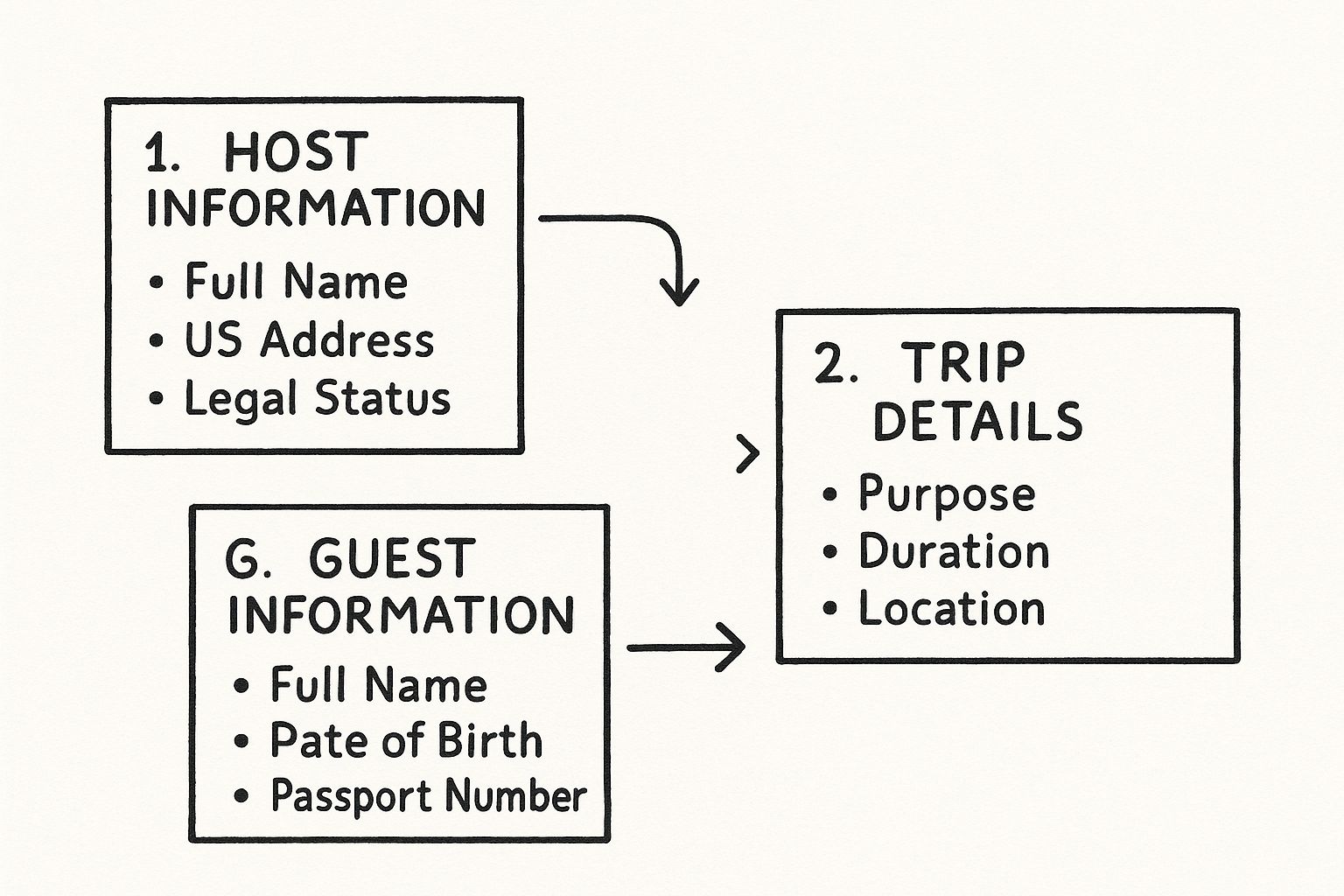
Why Are They Visiting? (The Trip Details)
This is where you connect all the dots. You need to clearly lay out the "why," "when," and "what" of the trip. The entire point here is to show that the visit is for a legitimate, temporary purpose and that your guest fully intends to return home.
Let’s look at a real-world example: Say you’re a U.S. citizen in California inviting your parents from Mexico to attend your college graduation. The letter should say the purpose is "to attend their son's graduation ceremony and spend time with family." You’d specify the travel dates, like from May 10th to May 30th. You’d also mention that they'll be staying at your home in California and that you have plans to visit landmarks like Yosemite National Park together.
This kind of detail proves the trip is well-thought-out and temporary. A clear purpose and itinerary are fundamental parts of the B-2 visa documents checklist that helps assure the officer of your guest's intent to return home.
Crafting a Powerful Invitation Letter: A Step-by-Step Example

Alright, let's move from the what to the how. The best way to understand the structure of a strong invitation letter is to walk through a real-world scenario. A well-written letter tells a clear, confident story, leaving no room for questions or doubt in the consular officer's mind.
Let's imagine Sofia, a lawful permanent resident who lives in Miami. She's about to graduate from university and wants her sister, Isabella, to fly in from Bogotá, Colombia for the ceremony. This is a great example because it shows how even a non-citizen resident can write an effective and persuasive letter.
Nail the Introduction
Your first paragraph needs to get straight to the point. Think of it as the executive summary. It should immediately state who you are, who you're inviting, and your relationship. There's no need for fluff here; just be direct and factual. This sets a professional, serious tone and gives the consular officer the most critical information upfront.
Here’s how Sofia could start her letter:
"My name is Sofia Rossi, and I am a lawful permanent resident of the United States, residing at 123 Palm Avenue, Miami, Florida. I am writing to formally invite my sister, Isabella Rossi, who lives in Bogotá, Colombia, to visit me in the U.S. from May 5, 2024, to May 20, 2024, to attend my graduation ceremony from the University of Miami."
See how efficient that is? In just a few lines, it covers the host's name and legal status, the visitor's name and relationship, and the specific purpose and dates of the trip. It preemptively answers the officer's first few questions.
Flesh Out the Details in the Body
This is where you'll fill in the story. You need to elaborate on the trip's purpose, share a bit about the itinerary, and—most importantly—clarify the financial arrangements. Every detail you add should reinforce the idea that this is a legitimate, temporary visit.
The "Why" and "What" of the Trip
Start by expanding on the reason for the visit. Why this event? What else will you do together?
Highlight the main event: Talk about the graduation ceremony—the date, time, and how much it means to you.
Sketch out other plans: Briefly mention other activities, like showing them around your city, visiting a famous landmark, or just spending quality time with family. This demonstrates a well-planned, genuine tourist trip, not a vague, open-ended stay.
Answering the Money Question
Next, you have to be crystal clear about who is paying for what. Any vagueness about finances is a massive red flag for consular officers.
Why this is so critical: Officers must be convinced that the visitor will not become a "public charge" (reliant on government assistance) or try to work illegally. Your letter needs to spell out exactly how the trip's expenses will be covered.
Here's a solid example of how to address the financials:
"During her stay, Isabella will be residing with me at my home. I will be responsible for all of her expenses in the United States, including accommodation, food, local transportation, and tourism activities. I have attached a copy of my recent bank statement and a letter from my employer as proof of my financial ability to support her visit."
This is powerful because it's direct and, crucially, backed by evidence. By mentioning the attached documents, you're not just making a promise—you're proving it.
The All-Important Conclusion
Your final paragraph has one primary job: to reassure the consular officer that your visitor has every intention of returning home. This is arguably the most critical part of the entire letter. The key is to connect their departure to specific, tangible responsibilities and ties in their home country.
Here's how Sofia can wrap it up:
"Isabella has strong ties to Colombia. She is a full-time student at the University of the Andes in Bogotá and is expected to return to her studies on June 1, 2024. Additionally, our parents and her entire social circle reside in Colombia. Her visit is purely for the purpose of celebrating my graduation and a short vacation. She will return to Bogotá on or before her intended departure date of May 20, 2024."
This conclusion works because it points to concrete ties—education and family—that give the officer compelling reasons to believe the visit is truly temporary. Follow this structure, and you'll have a clear, convincing, and supportive letter that significantly strengthens the visa application.
Common Mistakes That Can Weaken Your Letter
An invitation letter can be a powerful tool, but a poorly written one can do more harm than good. It’s not just about what you include, but also what you avoid. A vague, overly emotional letter, or one that lacks proof to back up its claims, can raise immediate red flags for a consular officer.
One of the most common missteps is being too general about the reason for the visit. Just saying your guest is coming for "tourism" or "to visit family" is too broad. Get specific. For example, "to attend my wedding on June 15th and then spend two weeks visiting national parks with us." Likewise, if you promise to cover their expenses, you absolutely must attach proof like a bank statement or a letter from your employer. Without it, your promise is just an empty claim.
Sounding Overly Emotional or Desperate
It’s completely understandable to be excited about seeing a friend or family member, but letting that emotion spill into the letter in the wrong way can backfire. Avoid phrases like, "we are begging you to approve this visa" or "it would be a tragedy if they can't come."
While the sentiment is genuine, it can come across as desperate or unprofessional to an official. This might make them question the real motives for the trip. The best approach is to keep the tone factual, polite, and confident. The strength of your letter of invitation for US visitor visa lies in its clarity and the evidence you provide, not in emotional appeals.
Accidentally Implying Permanent Intent
This is probably the most damaging mistake you can make. You have to be incredibly careful not to say anything that suggests the visitor might overstay their visa. Avoid language like "they can stay for as long as they want" or making plans that seem open-ended. The entire letter needs to reinforce the temporary nature of their stay.
Your letter's primary purpose is to support a temporary visit. Clearly state the exact travel dates and mention the visitor's commitments back home, such as a job, school enrollment, or family responsibilities. This proves their intent to leave the U.S. after their visit concludes.
This is more important now than ever. Recent analysis shows a 16% year-over-year drop in nonimmigrant visa issuances, and visitor visas have been hit the hardest. In this stricter environment, a clear, convincing letter that sidesteps these common errors is absolutely crucial. You can see more of the current immigration data from the Niskanen Center to understand the landscape.
Supporting Documents to Strengthen Your Invitation
Think of your invitation letter as the story you're telling the consular officer. Your supporting documents are the hard evidence that proves your story is true. Attaching the right paperwork to your letter of invitation for a US visitor visa is what turns your personal claims into verifiable facts. This is where you build trust and make the officer's job easier.
First things first, you absolutely have to prove your own legal status in the U.S. This is non-negotiable. You’ll need to include a crisp, clear copy of your U.S. passport, birth certificate, or Permanent Resident Card (Green Card). This one piece of paper immediately establishes your credibility as a legitimate host.
Proving Your Stability
Next up, you need to show that you have a stable, established life here. This isn't just about you; it's about demonstrating that you’re a reliable anchor for your guest during their visit.
A few key documents will get this done:
Proof of Address: A recent utility bill or a copy of your lease agreement works perfectly. It directly links your name to a physical address in the United States.
Proof of Employment: Ask your employer for a letter on company letterhead. It should confirm your job title, salary, and that you're an employee in good standing.
That employment letter is a heavy hitter. It does more than just show you can afford to host someone. It proves your strong ties to the U.S., which lends a lot of weight to the entire visa application.
Finally, if you’ve promised to cover your guest’s expenses, you have to back it up with proof. A recent bank statement showing you have the funds is the most straightforward way to do this. If you want to dive deeper into the financial side of things, our guide on the Affidavit of Support for a tourist visa has a lot more detail.
Remember, every document you add is another layer of proof, building a much more convincing case for getting that visa approved.
Answering Your Questions About Invitation Letters
When writing an invitation letter for a US visitor visa, a lot of questions can pop up. It's totally normal. Let's walk through some of the most common things people ask, so you can get this done right.
Does The Invitation Letter Have To Be Notarized?
This is a big one, and the short answer is no. A notary stamp isn't typically required.
What consular officers really care about is the substance of your letter. They want to see genuine, credible information about you, your guest, and the purpose of the trip. A heartfelt, detailed letter from you is always going to be more persuasive than a formal document with a stamp on it.
Who Is Eligible To Write An Invitation Letter?
The person writing the letter needs to be a U.S. citizen or a lawful permanent resident—that means a Green Card holder.
Your legal and stable status in the country is what gives your invitation weight. It shows the consulate that you're a credible host who can be trusted to welcome a visitor.
What If I Cannot Financially Support My Guest?
That's perfectly okay. If you're not in a position to cover all the costs, your guest just needs to show they can support themselves.
In your letter, you can simply state that you'll be providing a place to stay and maybe covering meals or local transportation. Then, your guest will need to back that up with their own proof of funds, like bank statements or a letter from their employer.
The key is honesty. Be clear about exactly what you can offer. As long as your guest has the documents to prove they can handle the rest, you're in good shape.
One last tip: always send the signed letter directly to your guest. They are the ones who need to submit it along with their visa application package. It’s part of their responsibility to bring all the required documents to their interview. Speaking of which, getting that interview scheduled can be a whole process in itself. For more on that, take a look at our guide to U.S. visa appointment booking.
Stuck waiting for a visa appointment? Vast Fisa finds and books earlier appointment slots for you automatically, turning months of waiting into just a few weeks. Skip the line and get your visa faster at https://www.vastfisa.com. Our service is currently available for applicants in Angola, Argentina, Bahamas, Barbados, Belize, Bolivia, Brazil, Canada, Chile, Colombia, Costa Rica, Curacao, Djibouti, Dominican Republic, Ecuador, El Salvador, Ethiopia, Guatemala, Guyana, Honduras, Ireland, Italy, Jamaica, Kazakhstan, Kenya, Mauritania, Mauritius, Mexico, Nicaragua, Panama, Paraguay, Peru, Portugal, South Africa, Spain, Suriname, Tanzania, Togo, Trinidad and Tobago, Uganda, United Kingdom, Uruguay, Uzbekistan, and Zambia.